Tree Skiing in Patagonia: Where to Find the Best Glades and Lenga Forest Runs
Tree skiing in Patagonia means lenga beech forest, soft snow and shelter from wind. Here is where to find the best glades near Bariloche and Villa La Angostura, and how to ski them safely.
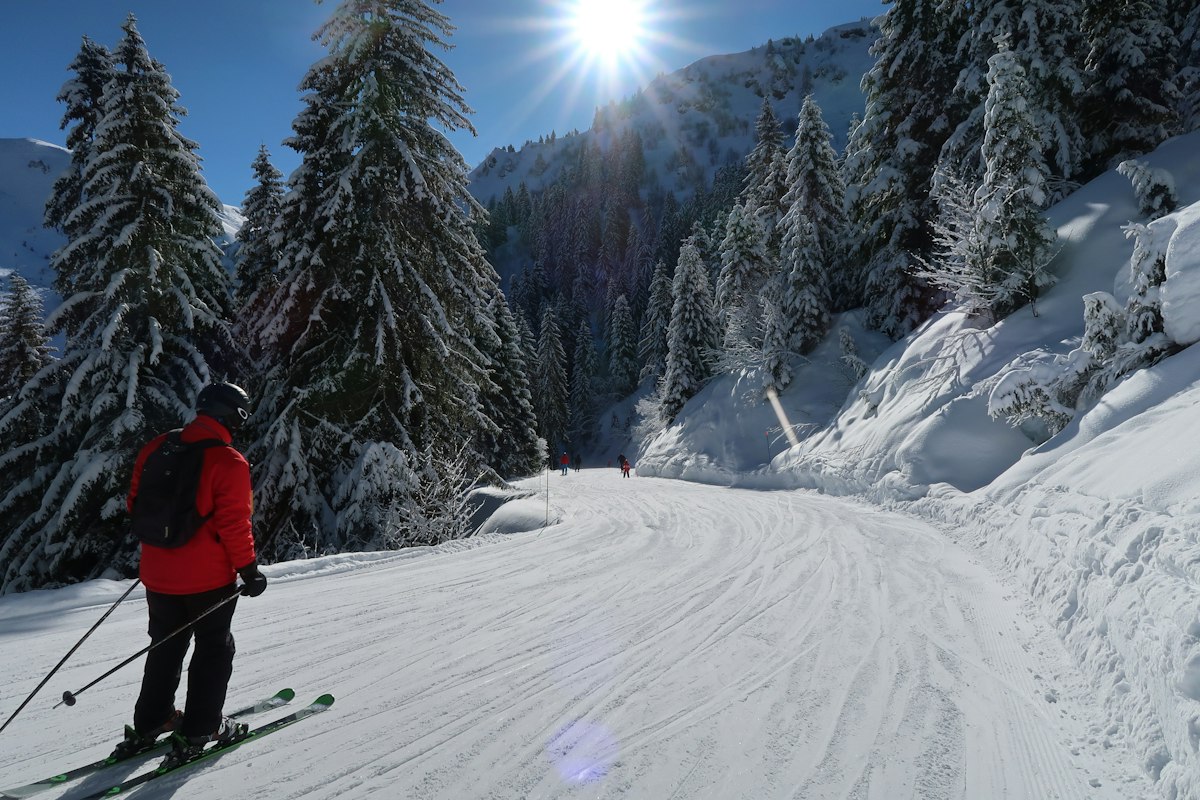
Tree skiing in Patagonia means skiing through lenga beech forest, and the best places to do it are Cerro Bayo in Villa La Angostura and the lower sectors of Cerro Catedral near Bariloche. The trees give you definition in flat light, protection from wind, and snow that stays soft longer than the open slopes above. It also brings real hazards, so go with a guide who knows the glades.
Quick Answer: Tree skiing in Patagonia
- Best resort for glades: Cerro Bayo, Villa La Angostura
- Main tree species: lenga (Nothofagus pumilio), a deciduous southern beech
- Tree line in the Nahuel Huapi region: roughly 1,600-1,800 m
- Best conditions: a day or two after a storm, when wind closes the upper lifts
- Minimum level: confident intermediate with good turn control on off-piste snow
- Guide cost for a day: commonly $250-$450 USD for a private guide, depending on group size
What is tree skiing like in Patagonia?
Tree skiing here is quieter and more open than in North America or Japan. Lenga forest is not a dense wall of conifers: the trees are broad, gnarled and spaced, and in winter they stand bare, so you see a long way between trunks. That gives you more line choice, but it also means gaps close up where the forest thickens near streams.
The forest sits mostly below 1,600 m, which is where most resort base areas and lower runs live. Above that you are in open bowls and rock. The result is a day that naturally splits in two: wind-exposed terrain high up, sheltered glades low down.
Where are the best glades near Bariloche and Villa La Angostura?
The best glade skiing in our region is at Cerro Bayo, followed by the forested lower flanks at Cerro Catedral and the wooded areas at Cerro Chapelco. Cerro Bayo is a smaller mountain, with roughly 120 hectares of terrain by our count, but much of it is surrounded by native forest, so a storm day there is rarely a lost day.
- Cerro Bayo (Villa La Angostura): the most forested of the resorts, with a calm, local feel. See our Cerro Bayo guide.
- Cerro Catedral (Bariloche): the big mountain at roughly 1,200 hectares, with tree-lined runs on the lower sectors that are good when upper lifts hold for wind.
- Cerro Chapelco (San Martin de los Andes): gentler tree runs, good for people building confidence.
For a wider view of the big mountain, read our Cerro Catedral guide.
When is the best time to ski the trees?
The best time for glades is 24 to 48 hours after a storm, between mid-July and mid-August, when the forest holds the new snow and the wind has not yet scoured it. In a typical season the trees hold powder for a day or two longer than open slopes because shade and shelter slow the damage from sun and gusts.
Early and late season are riskier. In June and again in September, lower elevations can run thin, and a single exposed log or rock under a shallow base can end a day. If the base at the bottom is under about 60 cm, we usually move the group to open terrain instead. Our season breakdown explains how conditions change week by week.
How do you stay safe skiing in the trees?
The first rule of tree skiing is never to ski alone, because tree wells and deep snow near trunks can bury a person even a few metres from a groomed run. Falling headfirst into the soft snow around a tree can trap a skier, and a partner who is not watching may not notice for minutes.
The habits we teach every group:
- Ski with a partner within sight and call out when you stop.
- Keep your speed under control; trees punish speed more than any other terrain.
- Stay out of the soft, hollow snow right next to trunks.
- Carry a whistle and keep your phone charged, since signal drops in the forest.
- Respect resort boundary ropes: tree runs beyond the boundary are not patrolled.
If you plan to leave the resort, you need avalanche training and gear. Read our notes on avalanche safety in the Andes first.
What gear and skills do you need for glades?
You need a ski with some float, a helmet, and the ability to make short, controlled turns. A waist width of about 90-105 mm covers most conditions we ski, and a helmet is non-negotiable in trees. Goggles with a low-light lens help, because forest shade flattens the light.
On skills, a confident intermediate who can handle a blue run in variable snow is ready for gentle glades with a guide. Tighter lines need quick pole planting and the habit of looking at the gap, not the tree. If you are building up, our post on moving from intermediate to expert at Catedral lays out a sensible progression.
Is it worth booking a guide for tree skiing?
Yes, because a guide gives you route knowledge, safety and speed. Forest lines are hard to read from the chairlift: a gap that looks open can close at a creek, and a guide knows which glades link back to the lifts and which dead-end.
A private guide for the day typically costs more than a group lesson, but a local often finds snow that holds for hours after the open runs are tracked out. For guests who want this kind of day, our off-piste experiences are built around it, with forest days planned for stormy weather.
Frequently Asked Questions
Can intermediate skiers try tree skiing in Patagonia? Yes, if you can link controlled turns on blue runs in soft snow. Start with wide, open glades at Cerro Bayo or lower Catedral, with a guide.
What is lenga forest? Lenga is a southern beech (Nothofagus pumilio) native to the Andes. It loses its leaves in winter, which makes the forest more open and easier to ski than evergreen woods.
Is tree skiing safer on a windy day? It is more comfortable, since the forest breaks the wind, but the hazards of tree wells and obstacles stay the same. Wind days are a good reason to move to the glades; see our guide on what to do when the lifts close.
Do I need avalanche gear in resort glades? Not inside patrolled resort terrain, but you do if you leave the boundary. Ask your guide what is in bounds that day.
This guide was written by the Ski Patagonia Co. team, based on many seasons of guiding in the forests of Cerro Bayo and Cerro Catedral and years operating across Patagonia.
Ready to plan your own trip? Tell us your dates, your level and what you want from the mountain, and we will build it around you. Start here with Plan My Trip.
Hero photo by William Jones on Unsplash